2016年5月13日 星期五

Week 12 Poetry 4

A black-and-white photo of Cummings standing in profile1.Edward Estlin Cummings (October 14, 1894 – September 3, 1962), known as E. E. Cummings, with the abbreviated form of his name often written by others in lowercase letters as e e cummings (in the style of some of his poems—see name and capitalization, below), was an American poet, painter, essayist, author, and playwright. His body of work encompasses approximately 2,900 poems, two autobiographical novels, four plays and several essays, as well as numerous drawings and paintings. He is remembered as an eminent voice of 20th century English literature.

"somewhere i have never travelled,gladly beyond"
https://www.poets.org/poetsorg/poem/somewhere-i-have-never-travelledgladly-beyond


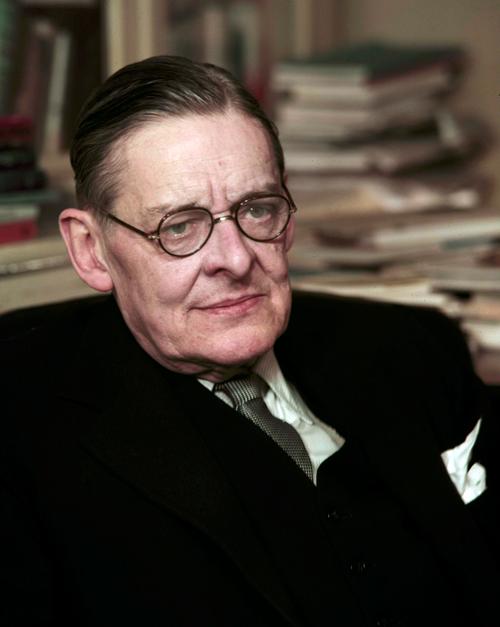
Thomas Stearns Eliot by Lady Ottoline Morrell (1934).jpg2.Thomas Stearns Eliot  (26 September 1888 – 4 January 1965), better known by his pen name T. S. Eliot, was an American-born British essayist, publisher, playwright, literary and social critic and "one of the twentieth century's major poets".He moved to England in 1914 at age 25, settling, working and marrying there. He was eventually naturalised as a British subject in 1927 at age 39, renouncing his American citizenship.


 It was followed by some of the best-known poems in the English language, including 'The Waste Land" (1922), "The Hollow Men" (1925), "Ash Wednesday" (1930) . He is also known for his seven plays, particularly Murder in the Cathedral (1935). He was awarded the Nobel Prize in Literature in 1948, "for his outstanding, pioneer contribution to present-day poetry".


 "The Waste Land" is a long poem by T. S. Eliot. It is widely regarded as one of the most important poems of the 20th century and a central text in Modernist poetry. Published in 1922, the 434-line poem first appeared in the United Kingdom in the October issue of The Criterion and in the United States in the November issue of The Dial. It was published in book form in December 1922. Among its famous phrases are "April is the cruellest month", "I will show you fear in a handful of dust", and the mantra in the Sanskrit language "Shantih shantih shantih".

Eliot's poem loosely follows the legend of the Holy Grail and the Fisher King combined with vignettes of contemporary British society. Eliot employs many literary and cultural allusions from the Western canon, Buddhism and the Hindu Upanishads. Because of this, critics and scholars regard the poem as obscure.The poem shifts between voices of satire and prophecy featuring abrupt and unannounced changes of speaker, location, and time and conjuring of a vast and dissonant range of cultures and literatures.

The poem's structure is divided into five sections. The first section, The Burial of the Dead, introduces the diverse themes of disillusionment and despair. The second, A Game of Chess, employs vignettes of several characters—alternating narrations—that address those themes experientially. The Fire Sermon, the third section, offers a philosophical meditation in relation to the imagery of death and views of self-denial in juxtaposition influenced by Augustine of Hippo and eastern religions. After a fourth section that includes a brief lyrical petition, the culminating fifth section, What the Thunder Said, concludes with an image of judgment.

http://www.bartleby.com/201/1.html


3.The Canterbury Tales is a collection of 24 stories that runs to over 17,000 lines written in Middle English by Geoffrey Chaucer. In 1386 Chaucer became Controller of Customs and Justice of Peace and then three years later in 1389 Clerk of the King's work. It was during these years that Chaucer began working on his most famous text, The tales (mostly written in verse, although some are in prose) are presented as part of a story-telling contest by a group of pilgrims as they travel together on a journey from London to Canterbury in order to visit the shrine of Saint Thomas Becket at Canterbury Cathedral. The prize for this contest is a free meal at the Tabard Inn at Southwark on their return.

 The Canterbury Tales is near-unanimously seen as Chaucer's magnum opus. He uses the tales and the descriptions of its characters to paint an ironic and critical portrait of English society at the time, and particularly of the Church. Chaucer's use of such a wide range of classes and types of people was without precedent in English. Although the characters are fictional, they still offer a variety of insights into the customs and practices of the time. Often, such insight leads to a variety of discussions and disagreements among people in the 14th century. For example, although various social classes are represented in these stories and all of the pilgrims are on a spiritual quest, it is apparent that they are more concerned with worldly things than spiritual.


4.The General Prologue is the first part of Chaucer's The Canterbury Tales.The frame story of the poem, as set out in the 858 lines of Middle English which make up the general prologue, is of a religious pilgrimage. The narrator, Geoffrey Chaucer, is in The Tabard Inn in Southwark, where he meets a group of "sundry folk" who are all on the way to Canterbury, the site of the shrine of Saint Thomas Becket.

The setting is April, and the prologue starts by singing the praises of that month whose rains and warm western wind restore life and fertility to the earth and its inhabitants. This abundance of life, the narrator says, prompts people to go on pilgrimages; in England, the goal of such pilgrimages is the shrine of Thomas Becket. The narrator falls in with a group of pilgrims, and the largest part of the prologue is taken up by a description of them


Walt Whitman - George Collins Cox.jpg5.Walter "Walt" Whitman ( May 31, 1819 – March 26, 1892) was an American poet, essayist and journalist. A humanist, he was a part of the transition between transcendentalism and realism, incorporating both views in his works. Whitman is among the most influential poets in the American canon, often called the father of free verse.His work was very controversial in its time, particularly his poetry collection" Leaves of Grass", which was described as obscene for its overt sexuality.


Born in Huntington on Long Island, Whitman worked as a journalist, a teacher, a government clerk, and—in addition to publishing his poetry—was a volunteer nurse during the American Civil War. Whitman's sexuality is often discussed alongside his poetry. Though biographers continue to debate his sexuality, he is usually described as either homosexual or bisexual in his feelings and attractions. However, there is disagreement among biographers as to whether Whitman had actual sexual experiences with men.

When Lilacs Last in the Dooryard Bloom’d
http://www.poetryfoundation.org/poems-and-poets/poems/detail/45480


6.William Butler Yeats (13 June 1865 – 28 January 1939) was an Irish poet and one of the foremost figures of 20th-century literature. A pillar of both the Irish and British literary establishments, in his later years he served as an Irish Senator for two terms. Yeats was a driving force behind the Irish Literary Revival and, along with Lady Gregory, Edward Martyn, and others, founded the Abbey Theatre, where he served as its chief during its early years. In 1923, he was awarded the Nobel Prize in Literature as the first Irishman so honoured for what the Nobel Committee described as "inspired poetry, which in a highly artistic form gives expression to the spirit of a whole nation".

Yeats is generally considered one of the twentieth century's key English language poets. He was a Symbolist poet, in that he used allusive imagery and symbolic structures throughout his career. Yeats chose words and assembled them so that, in addition to a particular meaning, they suggest other abstract thoughts that may seem more significant and resonant. His use of symbols is usually something physical that is both itself and a suggestion of other, perhaps immaterial, timeless qualities.

The Lake Isle of Innisfree
 http://www.poetryfoundation.org/poems-and-poets/poems/detail/43281


Benjamin Robert Haydon 002.jpg7.William Wordsworth (7 April 1770 – 23 April 1850) was a major English Romantic poet who, with Samuel Taylor Coleridge, helped to launch the Romantic Age in English literature with their joint publication Lyrical Ballads (1798).

Wordsworth's magnum opus is generally considered to be The Prelude, a semiautobiographical poem of his early years that he revised and expanded a number of times. It was posthumously titled and published, before which it was generally known as "the poem to Coleridge".[1] Wordsworth was Britain's Poet Laureate from 1843 until his death in 1850.


I Wandered Lonely as a Cloud
http://www.poetryfoundation.org/poems-and-poets/poems/detail/45521


AudenVanVechten1939.jpg8.Wystan Hugh Auden (21 February 1907 – 29 September 1973) was an Anglo-American poet, best known for love poems such as "Funeral Blues," Auden's poetry was noted for its stylistic and technical achievement, its engagement with politics, morals, love, and religion, and its variety in tone, form and content.He came to wide public attention at the age of twenty-three, in 1930, with his first book, Poems, followed in 1932 by The Orators.He won the Pulitzer Prize in Poetry for his 1947 long poem The Age of Anxiety, the title of which became a popular phrase describing the modern era.In 1956–61 he was Professor of Poetry at Oxford; his lectures were popular with students and faculty and served as the basis of his 1962 prose collection The Dyer's Hand.


Auden was a prolific writer of prose essays and reviews on literary, political, psychological and religious subjects, and he worked at various times on documentary films, poetic plays, and other forms of performance. Throughout his career he was both controversial and influential, and critical views on his work ranged from sharply dismissive, treating him as a lesser follower of W. B. Yeats and T. S. Eliot, to strongly affirmative, as in Joseph Brodsky's claim that he had "the greatest mind of the twentieth century".

Stop all the clocks, cut off the telephone http://homepages.wmich.edu/~cooneys/poems/auden.stop.html

Vocabulary


1.ann, enn- roots means "every years"
For Example- perennial, anniversary, annuity

2.sol- prefix means"lonely"
For Example- solitud


Video


https://www.youtube.com/watch?v=DDXWclpGhcg


2016年5月5日 星期四

Week 11 Poetry 2: Understanding the Text

Henrik Ibsen by Gustav Borgen NFB-19775.jpg1. Henrik Johan Ibsen (20 March 1828 – 23 May 1906) was a major 19th-century Norwegian playwright, theatre director, and poet. He is often referred to as "the father of realism" and is one of the founders of Modernism in theatre. He is the most frequently performed dramatist in the world after Shakespeare, and A Doll's House became the world's most performed play by the early 20th century.

                                                      
Ibsen wrote his plays in Danish (the common written language of Denmark and Norway) and they were published by the Danish publisher Gyldendal. Although most of his plays are set in Norway—often in places reminiscent of Skien, the port town where he grew up—Ibsen lived for 27 years in Italy and Germany, and rarely visited Norway during his most productive years.


A Doll's House  is a three-act play in prose by Henrik Ibsen. It premiered at the Royal Theatre in Copenhagen, Denmark, on 21 December 1879, having been published earlier that month.

The play is significant for its critical attitude toward 19th-century marriage norms. It aroused great controversy at the time,as it concludes with the protagonist, Nora, leaving her husband and children because she wants to discover herself. Ibsen was inspired by the belief that "a woman cannot be herself in modern society," since it is "an exclusively male society, with laws made by men and with prosecutors and judges who assess feminine conduct from a masculine standpoint." Its ideas can also be seen as having a wider application: Michael Meyer argued that the play's theme is not women's rights, but rather "the need of every individual to find out the kind of person he or she really is and to strive to become that person." In a speech given to the Norwegian Association for Women's Rights in 1898, Ibsen insisted that he "must disclaim the honor of having consciously worked for the women's rights movement," since he wrote "without any conscious thought of making propaganda," his task having been "the description of humanity."

In 2006, the centennial of Ibsen's death, A Doll's House held the distinction of being the world's most performed play for that year. UNESCO has inscribed Ibsen's autographed manuscripts of A Doll's House on the Memory of the World Register in 2001, in recognition of their historical value.


2.Marianne Moore- "poetry"
She mention that poetry is useful and unintelligible, also it is about 'literalists of imagination"-above insolence and triviality and can present for inspection."imaginary garden with real toads in them,"
Marianne Moore 1948 hires.jpg


A black-and-white photo of Cummings standing in profile3.Edward Estlin Cummings (October 14, 1894 – September 3, 1962), known as E. E. Cummings, with the abbreviated form of his name often written by others in lowercase letters as e e cummings (in the style of some of his poems—see name and capitalization, below), was an American poet, painter, essayist, author, and playwright. His body of work encompasses approximately 2,900 poems, two autobiographical novels, four plays and several essays, as well as numerous drawings and paintings. He is remembered as an eminent voice of 20th century English literature.

Despite Cummings's familiarity with avant-garde styles (undoubtedly affected by the Calligrammes of Apollinaire, according to a contemporary observation), much of his work is quite traditional. Many of his poems are sonnets, albeit often with a modern twist, and he occasionally made use of the blues form and acrostics. Cummings' poetry often deals with themes of love and nature, as well as the relationship of the individual to the masses and to the world. His poems are also often rife with satire.While his poetic forms and themes share an affinity with the romantic tradition, Cummings' work universally shows a particular idiosyncrasy of syntax, or way of arranging individual words into larger phrases and sentences. Many of his most striking poems do not involve any typographical or punctuation innovations at all, but purely syntactic ones.


4.Narrative poetry is a form of poetry that tells a story, often making use of the voices of a narrator and characters as well; the entire story is usually written in metred verse. Narrative poems do not have to follow rhythmic patterns. The poems that make up this genre may be short or long, and the story it relates to may be complex. It is normally dramatic, with objectives, diverse characters, and metre. Narrative poems include epics, ballads, idylls, and lays.An example of narrative poetry is Edward arlington Robinson-"Richard Cory".


6.La Belle Dame Sans Merci (French for "The Beautiful Lady Without Mercy") is a ballad written by the English poet John Keats. It exists in two versions, with minor differences between them. The original was written by Keats in 1819. He used the title of the 15th-century La Belle Dame sans Mercy by Alain Chartier, though the plots of the two poems are different.

John Keats by William Hilton.jpgThe poem is considered an English classic, stereotypical of other of Keats' works. It avoids simplicity of interpretation despite simplicity of structure. At only a short twelve stanzas, of only four lines each, with a simple ABCB rhyme scheme, the poem is nonetheless full of enigmas, and has been the subject of numerous interpretations.
 

John Keats ( 31 October 1795 – 23 February 1821) was an English Romantic poet. He was one of the main figures of the second generation of Romantic poets, along with Lord Byron and Percy Bysshe Shelley, despite his work having been in publication for only four years before his death.

Although his poems were not generally well received by critics during his lifetime, his reputation grew after his death, and by the end of the 19th century, he had become one of the most beloved of all English poets. He had a significant influence on a diverse range of poets and writers. Jorge Luis Borges stated that his first encounter with Keats's work was the most significant literary experience of his life.

The poetry of Keats is characterised by sensual imagery, most notably in the series of odes. This is typical of romantic poets, as they aimed to accentuate extreme emotion through the emphasis of natural imagery. Today his poems and letters are some of the most popular and most analysed in English literature.


6.Dionysus  is the god of the grape harvest, winemaking and wine, of ritual madness, fertility,theatre and religious ecstasy in Greek mythology. Alcohol, especially wine, played an important role in Greek culture with Dionysus being an important reason for this life style
                                                     Dionysos Louvre Ma87 n2.jpg


7. Semele in Greek mythology, daughter of the Boeotian hero Cadmus and Harmonia, was the mortal mother of Dionysus by Zeus in one of his many origin myths.Certain elements of the cult of Dionysus and Semele came from the Phrygians. These were modified, expanded and elaborated by the Ionian Greek invaders and colonists. Herodotus, who gives the account of Cadmus, estimates that Semele lived sixteen hundred years before his time, or around 2000 BCE.In Rome, the goddess Stimula was identified as Semele.


8. The dithyramb was an ancient Greek hymn sung and danced in honor of Dionysus, the god of wine and fertility; the term was also used as an epithet of the god:Plato, in The Laws, while discussing various kinds of music mentions "the birth of Dionysos, called, I think, the dithyramb." Plato also remarks in the Republic that dithyrambs are the clearest example of poetry in which the poet is the only speaker.


Vocabulary

1.rhyme /raɪm/noun - Correspondence of sound between words or the endings of words, especially when these are used at the ends of lines of poetry.
For Example-Poetic features such as rhythm, rhyme, and alliteration.

2.sarcasm/ˈsɑr kæz əm/ noun-The use of irony to mock or convey contempt
For Example-she didn’t like the note of sarcasm in his voice.


2016年4月27日 星期三

Week 10 :Poetry 1: Reading, Responding, Writing

1.Poetry is a form of literature that uses aesthetic and rhythmic qualities of language—such as phonaesthetics, sound symbolism, and metre—to evoke meanings in addition to, or in place of, the prosaic ostensible meaning.

Poetry uses forms and conventions to suggest differential interpretation to words, or to evoke emotive responses. Devices such as assonance, alliteration, onomatopoeia and rhythm are sometimes used to achieve musical or incantatory effects. The use of ambiguity, symbolism, irony and other stylistic elements of poetic diction often leaves a poem open to multiple interpretations.
                                                   

2.Archibald Macleish’s "Ars Poetica"
(May 7, 1892 – April 20, 1982) was an American poet, writer, and the Librarian of Congress. He is associated with the Modernist school of poetry. He received three Pulitzer Prizes for his work.MacLeish worked to promote the arts, culture, and libraries. Among other impacts, MacLeish was the first Librarian of Congress to begin the process of naming what would become the United States Poet Laureate. The Poet Laureate Consultant in Poetry to the Library of Congress came from a donation in 1937 from Archer M. Huntington, a wealthy ship builder. Like many donations it came with strings attached. In this case Huntington wanted the poet Joseph Auslander to be named to the position. MacLeish found little value in Auslander’s writing. However, MacLeish was happy that having Auslander in the post attracted many other poets, such as Robinson Jeffers and Robert Frost, to hold readings at the library. He set about establishing the consultantship as a revolving post rather than a lifetime position.

http://www.poetryfoundation.org/poetrymagazine/poems/detail/17168


3.Marianne Craig Moore (November 15, 1887 – February 5, 1972) was an American Modernist poet, critic, translator, and editor. Her poetry is noted for formal innovation, precise diction, irony, and wit.Her most famous poem is perhaps the one entitled, appropriately, "Poetry", in which she hopes for poets who can produce "imaginary gardens with real toads in them". It also expressed her idea that meter, or anything else that claims the exclusive title "poetry", is not as important as delight in language and precise, heartfelt expression in any form. Moore's meter was radically separate from the English tradition; writing her syllabic poems after the advent of free verse, she was thereby encouraged to try previously unusual meters.

Moore often composed her poetry in syllabics, she used stanzas with a predetermined number of syllables as her "unit of sense", with indentation underlining the parallels, the shape of the stanza indicating the syllabic disposition, and her reading voice conveying the syntactical line. These syllabic lines from "Poetry" illustrate her position: poetry is a matter of skill and honesty in any form whatsoever, while anything written poorly, although in perfect form, cannot be poetry.

https://en.wikisource.org/wiki/Poetry_(Moore)


4.Edward Arlington Robinson’s “Richard Cory”
(December 22, 1869––April 6, 1935) was an American poet who won three Pulitzer Prizes for his work,Robinson is considered unique among American poets of his time for his devotion to his art; he published virtually nothing during his long career except poetry. “The expense of Robinson’s single-mindedness,” Gilbert explained, “was virtually everything else in life for which people strive, but it eventually won for him both fortune and fame, as well as a firm position in literary history as America’s first important poet of the twentieth century.

https://en.wikipedia.org/wiki/Richard_Cory


5.William Wordsworth’s "I wandered lonely as a cloud"
(7 April 1770 – 23 April 1850) was a major English Romantic poet who, with Samuel Taylor Coleridge, helped to launch the Romantic Age in English literature with their joint publication Lyrical Ballads (1798).Wordsworth's magnum opus is generally considered to be The Prelude, a semiautobiographical poem of his early years that he revised and expanded a number of times. It was posthumously titled and published, before which it was generally known as "the poem to Coleridge".Wordsworth was Britain's Poet Laureate from 1843 until his death in 1850.
                              

The inspiration for the poem came from a walk Wordsworth took with his sister Dorothy around Glencoyne Bay, Ullswater, in the Lake District.He would draw on this to compose "I Wandered Lonely as a Cloud" in 1804, inspired by Dorothy's journal entry describing the walk:

http://www.poetryfoundation.org/poems-and-poets/poems/detail/45521


6."Ode to the West Wind" is an ode, written by Percy Bysshe Shelley in 1819 near Florence, Italy. It was published in 1820 Some have interpreted the poem as the speaker lamenting his inability to directly help those in England owing to his being in Italy. At the same time, the poem expresses the hope that its words will inspire and influence those who read or hear it.Perhaps more than anything else, Shelley wanted his message of reform and revolution spread, and the wind becomes the trope for spreading the word of change through the poet-prophet figure. Some also believe that the poem is due to the loss of his son, William in 1819. His son Charles (to Harriet Shelley) died in 1826, after "Ode to the West Wind" was written and published. The ensuing pain influenced Shelley. The poem allegorises the role of the poet as the voice of change and revolution.


7. "Stop all the clocks"is a poem by W. H. Auden. An early version was published in 1936, but the poem in its final, familiar form was first published in The Year's Poetry (London,1938).

Wystan Hugh Auden(21 February 1907 – 29 September 1973) was an Anglo-American poet,
He was born in York, grew up in and near Birmingham in a professional middle-class family. He attended English independent  schools and studied English at Christ Church, Oxford. After a few months in Berlin in 1928–29 he spent five years teaching in English public schools, then travelled to Iceland and China in order to write books about his journeys.

http://homepages.wmich.edu/~cooneys/poems/auden.stop.html


 8.Comparation of fable, parable and allegory

The concept of allegory you are talking about is called personification and has been mainly used in literature in medieval times and the baroque.There are other types of allegories, like in the Hebrew Bible, let's say Psalm 80, talking about the vine that stands for Israel. Things, as the vine, and actions can be allegorical.In arts there are many allegorical pictures. A personification would be Justice as a blindfolded woman with scales.


Fables are a subcategory of allegories, as are parables. Both probably are characterized by shortness.All three categories are forms of writing, art, or spoken utterance that encourage readers to look for meanings beyond what is said. 

As for the difference between fable and parable: the fable,has animals, plants, or objects acting. It therefore has to anthropomorphize, while a parable draws its images from human interaction mostly.
Therefore a fable most the time is more schematic in build and easier to decipher. Parables often allow for different ways of deciphering. Looking at Kafka, Brecht, or biblical parables, it is clear that there is often a key, hint, or explanation needed to decipher the parable.

This might be because a fable describes something that is naturally not possible, as the actors are anthropomorphized, creating its moral effect using striking simplification, while the parable describes a naturally possible incident, allowing for more complexity due to acquaintance, creating its moral or parabolic effect through surprise. Fable and parable therefore have much in common and overlap greatly.


Vocabulary


1. fra-prefix means"break"
For example-fraud,fragile,frailty

2.tri-prefix means"three"
For example-triangle,trigonometry,trichromatic

3.-nomy-prefix means"study"
For example-astronomy,gastronomy,economy


Movie


PS I Love You (film).jpg
 
P.S.I love you is a 2007 American drama film directed by Richard LaGravenese. The screenplay by LaGravenese and Steven Rogers is based on the 2004 novel of the same name by Cecelia Ahern. It stars Hilary Swank, Gerard Butler, Lisa Kudrow, Gina Gershon, James Marsters, Harry Connick, Jr. and Jeffrey Dean Morgan. It was distributed by Warner Bros. Pictures and Momentum Pictures.

https://www.youtube.com/watch?v=CZzW6_hR068


Week9 Midterm (on Fiction)

2016年4月13日 星期三

Week 8 Fiction 6: Exploring context


1.Rose of Emily is a short story by American author William Faulkner first published in April 30, 1930 issue of The Forum. The story takes place in Faulkner's fictional city, Jefferson, Mississippi, in the fictional county of Yoknapatawpha County. It was Faulkner's first short story published in a national magazine.

William Cuthbert Faulkner (September 25, 1897 – July 6, 1962) was an American writer and Nobel Prize laureate from Oxford, Mississippi. Faulkner wrote novels, short stories, a play, poetry, essays, and screenplays. He is primarily known for his novels and short stories set in the fictional Yoknapatawpha County, based on Lafayette County, Mississippi, where he spent most of his life.

Faulkner is one of the most celebrated writers in American literature generally and Southern literature specifically. Faulkner was relatively unknown until receiving the 1949 Nobel Prize in Literature, for which he became the only Mississippi-born Nobel winner. Two of his works, A Fable (1954) and his last novel The Reivers (1962), won the Pulitzer Prize for Fiction. In 1998, the Modern Library ranked his 1929 novel The Sound and the Fury sixth on its list of the 100 best English-language novels of the 20th century; also on the list were As I Lay Dying (1930) and Light in August (1932). Absalom, Absalom! (1936) is often included on similar lists.


Yoknapatawpha County is a fictional county created by the American author William Faulkner, based upon and inspired by Lafayette County, Mississippi, and its county seat of Oxford, Mississippi. Faulkner would often refer to Yoknapatawpha County as "my apocryphal county". From Sartoris onwards, Faulkner would set all but three of his novels in the county.
Faulkner added a map of Yoknapatawpha County at the end of Absalom, Absalom! Contemporary scholars are attempting to map the locations of all Faulkner's fiction.

The word Yoknapatawpha  is derived from two Chickasaw words—Yocona and petopha, meaning "split land." Faulkner claimed to a University of Virginia audience that the compound means "water flows slow through flat land." Yoknapatawpha was the original name for the actual Yocona River, a tributary of the Tallahatchie which runs through the southern part of Lafayette County,of which Oxford is the seat.


2.Grendel is a 1971 novel by American author John Gardner. It is a retelling of part of the Old English poem Beowulf from the perspective of the antagonist, Grendel. In the novel, Grendel is portrayed as an antihero. The novel deals with finding meaning in the world, the power of literature and myth, and the nature of good and evil.

In a 1973 interview, Gardner said that "In Grendel I wanted to go through the main ideas of Western Civilization – which seemed to me to be about . . . twelve?'' – and go through them in the voice of the monster, with the story already taken care of, with the various philosophical attitudes (though with Sartre in particular), and see what I could do, see if I could break out". On another occasion he noted that he" used Grendel to represent Sartre's philosophical position" and that "a lot of Grendel is borrowed from sections of Sartre's Being and Nothingness.

Grendel has become one of Gardner's best known and reviewed works. Several editions of the novel contain pen and ink line drawings of Grendel's head, by Emil Antonucci.Gardner himself explained that his Grendel character is modeled on Jean-Paul Sartre, with whom Gardner claimed to have a love-hate relationship: "he's a horror intellectually, figuratively, and morally, but he's a wonderful writer and anything he says you believe, at least for the moment, because of the way he says it....What happened in Grendel was that I got the idea of presenting the Beowulf monster as Jean-Paul Sartre, and everything that Grendel says Sartre in one mood or another has said".


An antihero is a protagonist who lacks conventional heroic qualities such as idealism, courage, or morality.These individuals often possess dark personality traits such as disagreeableness, dishonesty, and aggressiveness. These characters are usually considered "conspicuously contrary to an archetypal hero".


John Champlin Gardner Jr. (July 21, 1933 – September 14, 1982) was an American novelist, essayist, literary critic and university professor. He is perhaps most noted for his novel Grendel, a retelling of the Beowulf myth from the monster's point of view.


3.Beowulf  is an Old English epic poem consisting of 3182 alliterative lines. It is the oldest surviving long poem in Old English and is commonly cited as one of the most important works of Old English literature. It was written in England some time between the 8th[and the early 11th century.The author was an anonymous Anglo-Saxon poet.

The poem is set in Scandinavia. Beowulf, a hero of the Geats, comes to the aid of Hrothgar, the king of the Danes, whose mead hall in Heorot has been under attack by a monster known as Grendel. After Beowulf slays him, Grendel's mother attacks the hall and is then also defeated. Victorious, Beowulf goes home to Geatland (Götaland in modern Sweden) and later becomes king of the Geats. After a period of fifty years has passed, Beowulf defeats a dragon, but is fatally wounded in the battle. After his death, his attendants cremate his body and erect a tower on a headland in his memory.

The full poem survives in the manuscript known as the Nowell Codex, located in the British Library. It has no title in the original manuscript, but has become known by the name of the story's protagonist. In 1731, the manuscript was badly damaged by a fire that swept through Ashburnham House in London that had a collection of medieval manuscripts assembled by Sir Robert Bruce Cotton.


4.The Mental Traveller is a poem by William Blake. It is part of a collection of unpublished works called The Pickering Manuscript and was written in a manner that suggests the poem was to be read directly from the collection.

The poem is about travelling in the realm of the mind. Blake generalizes here "about the spiritual history of mankind out the experience of his own spiritual history." It can be also understood as a cycle history of relations between society and idea of liberty in the form of a male and female that grow older and younger in opposition to the other experiencing such changes. As a whole, the poem portrays conflicting ideas that make it difficult for the reader to attach to any given viewpoint.


William Blake (28 November 1757 – 12 August 1827) was an English poet, painter, and printmaker. Largely unrecognised during his lifetime, Blake is now considered a seminal figure in the history of the poetry and visual arts of the Romantic Age. His prophetic poetry has been said to form "what is in proportion to its merits the least read body of poetry in the English language".His visual artistry led one contemporary art critic to proclaim him "far and away the greatest artist Britain has ever produced". In 2002, Blake was placed at number 38 in the BBC's poll of the 100 Greatest Britons. He also lived in London his entire life.


5.The Waste Land is a long poem by T. S. Eliot. It is widely regarded as one of the most important poems of the 20th century and a central text in Modernist poetry. Published in 1922, the 434-line poem first appeared in the United Kingdom in the October issue of The Criterion and in the United States in the November issue of The Dial. It was published in book form in December 1922. Among its famous phrases are "April is the cruellest month", "I will show you fear in a handful of dust".

Eliot's poem loosely follows the legend of the Holy Grail and the Fisher King combined with vignettes of contemporary British society. Eliot employs many literary and cultural allusions from the Western canon, Buddhism and the Hindu Upanishads. Because of this, critics and scholars regard the poem as obscure. The poem shifts between voices of satire and prophecy featuring abrupt and unannounced changes of speaker, location, and time and conjuring of a vast and dissonant range of cultures and literatures.


Thomas Stearns Eliot  (26 September 1888 – 4 January 1965), better known by his pen name T. S. Eliot, was an American-born British essayist, publisher, playwright, literary and social critic and "one of the twentieth century's major poets". He was awarded the Nobel Prize in Literature in 1948, "for his outstanding, pioneer contribution to present-day poetry".


6.The Canterbury Tales is a collection of 24 stories that runs to over 17,000 lines written in Middle English by Geoffrey Chaucer. In 1386 Chaucer became Controller of Customs and Justice of Peace and then three years later in 1389 Clerk of the King's work. It was during these years that Chaucer began working on his most famous text, The Canterbury Tales. The tales  are presented as part of a story-telling contest by a group of pilgrims as they travel together on a journey from London to Canterbury in order to visit the shrine of Saint Thomas Becket at Canterbury Cathedral. The prize for this contest is a free meal at the Tabard Inn at Southwark on their return.

After a long list of works written earlier in his career, including Troilus and Criseyde, House of Fame, and Parliament of Fowls, The Canterbury Tales is near-unanimously seen as Chaucer's magnum opus. He uses the tales and the descriptions of its characters to paint an ironic and critical portrait of English society at the time, and particularly of the Church. Chaucer's use of such a wide range of classes and types of people was without precedent in English.

 Although the characters are fictional, they still offer a variety of insights into the customs and practices of the time. Often, such insight leads to a variety of discussions and disagreements among people in the 14th century. For example, although various social classes are represented in these stories and all of the pilgrims are on a spiritual quest, it is apparent that they are more concerned with worldly things than spiritual. Structurally, the collection resembles The Decameron, which Chaucer may have read during his first diplomatic mission to Italy in 1372.


Geoffrey Chaucer ( c. 1343 – 25 October 1400), known as the Father of English literature, is widely considered the greatest English poet of the Middle Ages and was the first poet to be buried in Poets' Corner of Westminster Abbey.While he achieved fame during his lifetime as an author, philosopher, and astronomer, composing a scientific treatise on the astrolabe for his ten-year-old son Lewis, Chaucer also maintained an active career in the civil service as a bureaucrat, courtier and diplomat.


7.The Decameron subtitled Prince Galehaut , is a collection of novellas by the 14th-century Italian author Giovanni Boccaccio The book is structured as a frame story containing 100 tales told by a group of seven young women and three young men sheltering in a secluded villa just outside Florence to escape the Black Death, which was afflicting the city. Boccaccio probably conceived the Decameron after the epidemic of 1348, and completed it by 1353. The various tales of love in The Decameron range from the erotic to the tragic. Tales of wit, practical jokes, and life lessons contribute to the mosaic. In addition to its literary value and widespread influence,it provides a document of life at the time. Written in the vernacular of the Florentine language, it is considered a masterpiece of classical early Italian prose.


Giovanni Boccaccio(1313 – 21 December 1375) was an Italian writer, poet, correspondent of Petrarch, and an important Renaissance humanist. Boccaccio wrote a number of notable works, including The Decameron and On Famous Women. He wrote in the Italian vernacular and is particularly noted for his realistic dialogue which differed from that of his contemporaries, medieval writers who usually followed formulaic models for character and plot.


8.In Greek mythology, Danaë was the daughter, and only child of King Acrisius of Argos and his wife Queen Eurydice. She was the mother of the hero Perseus by Zeus. She was credited with founding the city of Ardea in Latium during the Bronze Age.


Disappointed by his lack of male heirs, King Acrisius asked the oracle of Delphi if this would change. The oracle announced to him that he would never have a son, but his daughter would, and that he would be killed by his daughter's son. At the time, Danae was childless and, meaning to keep her so, King Acrisius shut her up in a bronze chamber to be constructed under the court of his palace . She was buried in this tomb, never to see the light again. However, Zeus, the king of the gods, desired her, and came to her in the form of golden rain which streamed in through the roof of the subterranean chamber and down into her womb. Soon after, their child Perseus was born.


 Perseus is the legendary founder of Mycenae and of the Perseid dynasty of Danaans, was, alongside Cadmus and Bellerophon, the greatest Greek hero and slayer of monsters before the days of Heracles. Perseus beheaded the Gorgon Medusa and saved Andromeda from the sea monster Cetus. Perseus was the son of the mortal Danaë and the god Zeus. He was also the great grandfather of Heracles, also a son of Zeus.


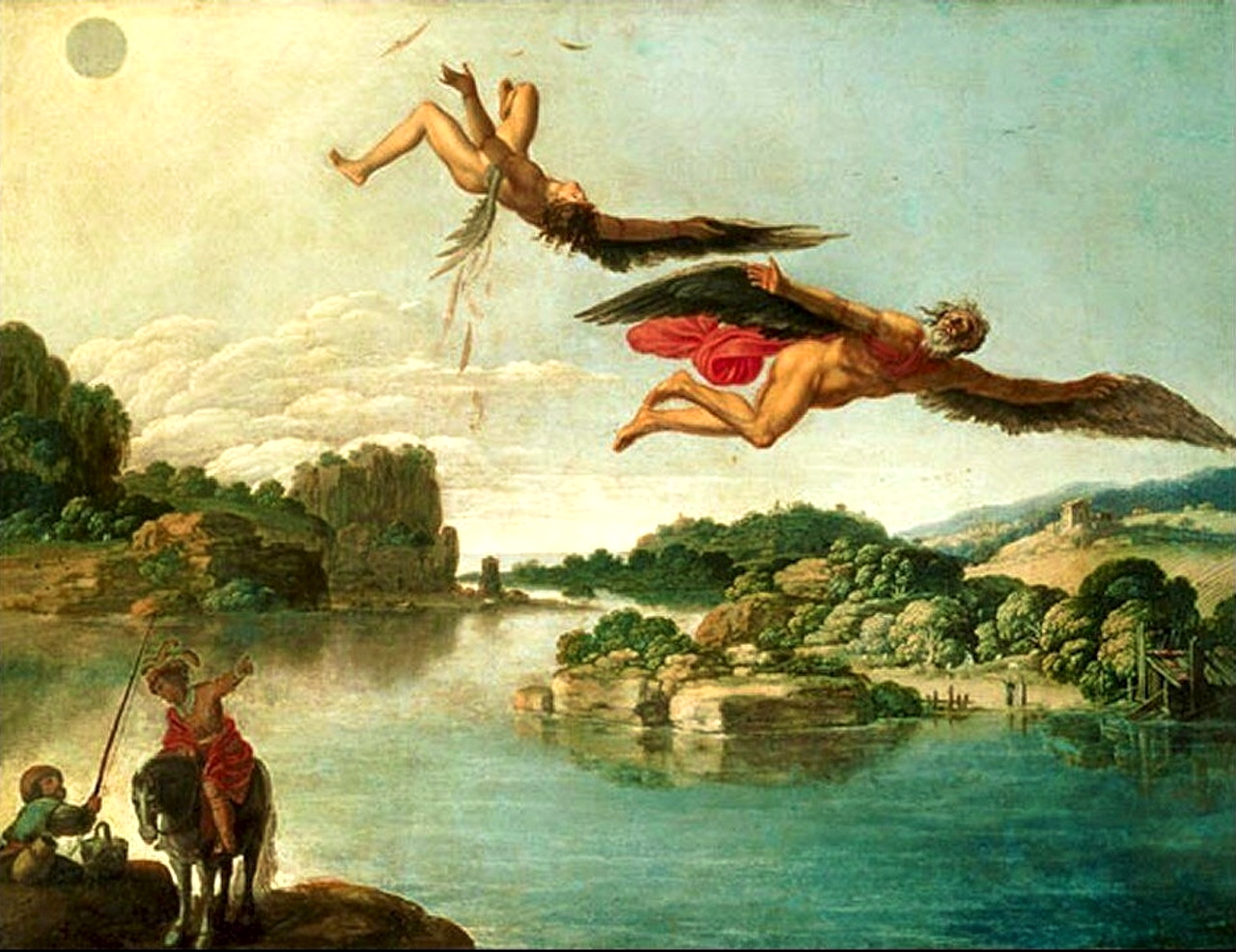
9.In Greek mythology, Icarus is the son of the master craftsman Daedalus, the creator of the Labyrinth. Often depicted in art, Icarus and his father attempt to escape from Crete by means of wings that his father constructed from feathers and wax. Icarus's father warns him first of complacency and then of hubris, asking that he fly neither too low nor too high, so the sea's dampness would not clog his wings or the sun's heat melt them. Icarus ignored his father's instructions not to fly too close to the sun, whereupon the wax in his wings melted and he fell into the sea. This tragic theme of failure at the hands of hubris contains similarities to that of Phaëthon.

Vocabulary

1.pilgrimages/ˈpɪl grə mɪdʒ/-a journey, especially a long one, made to some sacred place as an act of religious devotion.

For Example-For the past 13 years my family has made the pilgrimage to Willits, California, to spend the second week of August at Emandal.

2.paraphrase/ˈpær əˌfreɪz/-a restatement of a text or passage giving the meaning in another form, as for clearness; rewording.

For Example-The new Jim Crow, enforced not with burning crosses but with fountain pens, to paraphrase Woody Guthrie.

Movie


Other boleyn girl post.jpghttps://www.youtube.com/watch?v=NX0LoorqtRM

The Other Boleyn Girl is a 2008 drama film directed by Justin Chadwick. The screenplay by Peter Morgan was adapted from the 2001 novel of the same name by Philippa Gregory. It is a romanticized account of the lives of 16th-century aristocrats Mary Boleyn, one-time mistress of King Henry VIII, and her sister, Anne, who became the monarch's ill-fated second wife, though much history is distorted.